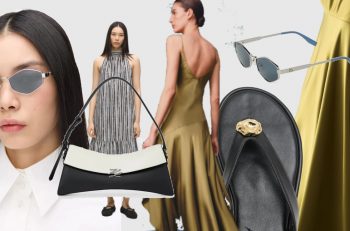
At Eltham Palace, where Tudor history meets art-deco glamour, Creative Director Seán McGirr orchestrates a subtle rebellion in fashion. Here, Savile Row precision collides with unrestrained elegance, redefining what it means to be sophisticated in 2025.
Alexander McQueen’s Spring/Summer 2026 pre-collection is more than clothing – it’s a sensory narrative of rebellion, refinement, and poetic tension, captured in every seam, embellishment, and silhouette. From shattered chandeliers to deconstructed tartans, this is fashion as theatre, inviting the modern aesthete to step inside a world where elegance flirts with audacity – and every detail tells a story.

There is a particular sound a crystal glass makes when it shatters – a high, clear punctuation to the end of an evening. It is the sound of a boundary broken, a final note of revelry before the sober dawn. It is also, rather fittingly, the silent soundtrack to Alexander McQueen’s Spring Summer 2026 pre-collection. Here, in the art deco opulence and Tudor bones of London’s Eltham Palace, Creative Director Seán McGirr does not simply present clothes; he stages a exquisitely tailored frisson. Imagine, if you will, the ghost of a country house party photographed by Dafydd Jones – all The Last Hurrah’s delicious unraveling of aristocratic formality – filtered through the subversive, skull-embossed lens of the house codes. This is not an escape from something, but an escape into a more poetic kind of tension.
The narrative is one of elegant friction. Heritage submits, willingly it seems, to a new hedonism. It’s a feeling any cosmopolitan dweller – from the penthouses of DIFC to the art-lofts of Alserkal – intimately knows: the craving for stately abandon, for a reprieve where one’s irreverence can be worn as lightly as a cashmere shawl. McGirr captures this duality not with brash contrast, but with sophisticated layering. Washed denim, that universal badge of casual rebellion, is here disciplined by narrow tailoring and cummerbund waistbands. It’s a uniform for the creatively restless, for those who understand that true modernism often wears a cinched waist.
View this post on Instagram
The collection unfolds like a filmic sequence, moving from the intimate, chandelier-lit interior to the liberating ambiguity of the grounds. Within, the simmering tension between rebellion and romanticism is rendered in breathtaking detail. Shattered chandelier embroideries cascade across black silk, a metaphor for fragile beauty and deliberate disruption made wearable. Suits are cut with a Savile Row-level of precision – think Anderson & Sheppard’s ghost summoned for a punk – but are sliced so close to the body they hum with a kind of restrained energy. The polished metal T-Bar, clashing with black-tie elegance, is the kind of subtle, witty accessory that speaks volumes in a silent room.
Then, we step outside. British outerwear is weathered and returned to the urbane psyche. Waxed cotton country jackets and gabardine car coats – fabrics that whisper of misty moors and Land Rover Defenders – are cinched, deconstructed, and sculpted into definitively McQueen silhouettes. They are armoured yet fluid, perfect for a Dubai winter that demands style as a shield against both climate and convention. Archival McQueen tartan and gossamer florals are similarly re-engineered; deconstructed and set free in asymmetric hems and layered drifts of fabric. It’s a pastoral romance, yes, but one viewed through a sharply contemporary lens.

The accessories are not mere footnotes but exclamation points in this sartorial essay. The reimagined Manta bag – first seen in SS2010 and now resurrected with supple, architectural grace and adjustable geometry – is a collector’s item waiting to happen. Adorned with characterful bag charms, it winks at the playful accessory maximalism of a Simone Rocha while retaining its lethal elegance. Footwear splits the difference between razor-sharp seduction and pragmatic chic: the iconic Skull pumps, now with a gleaming heel charm, stand opposite equestrian-inspired Countryside boots, detailed with utilitarian zips and buckles. It’s the sartorial equivalent of debating between a night at Galaxy Bar or an early-morning desert safari.
Jewellery deepens the narrative of fractured elegance. Fringed, cut-crystal Chandelier pieces scatter light with every movement, while Skull and Pearl creations continue the house’s memento mori dialogue with refined irony. The fabric story, meanwhile, is a masterclass in tactile intelligence. Heritage wools from British mills, silks printed with oxblood skulls or spiderweb florals, and endurance cotton gabardines speak to a commitment to craft that transcends seasonal noise. It’s a palette and texture story that would resonate in the curated minimalism of a Aati gallery opening or against the dramatic backdrop of The Lana’s lobby.
Captured through the lens of Sammy Khoury, the campaign carries a faint, deliberate echo of Saltburn’s unsettling pastoral glamour – that same sense of beauty tinged with decadent possibility. Under McGirr’s direction, McQueen asserts that rebellion in our era is rarely a shout. It is a whisper in a historic hall, the precise drape of a re-engineered tartan, the conscious clash of a polished metal bar against a satin lapel. It is, in essence, the quiet, thrilling sound of a chandelier shattering, and the decision to wear its fragments as the most exquisite embroidery. For a generation fluent in nuance, seeking sophistication beyond mere logo, this is their invitation to the last hurrah – and the elegant, rebellious dawn that follows.