In Al Quoz, where the scent of roasting coffee now competes with the ghost of tyre rubber, a basketball icon has built something that is either the future of luxury wellness or a very expensive existential crisis. Possibly both. Either way, your rest day is cancelled.
There is a particular kind of Dubai morning – say, 6.04am on a Friday – when the city’s strivers, dressed in matching Lululemon sets and armed with carefully calibrated cortisol levels, begin their pilgrimage. They are not heading to brunch. Brunch, for the younger, wealthier set, has been quietly defrocked; the bottomless prosecco of yesteryear has been replaced by the bottomless cold plunge. Wellness, we are told, is the new hedonism. Or perhaps it is simply hedonism with better bloodwork. Into this spiritually ambiguous arena steps Club 15, a 15,000-square-metre sports and lifestyle destination in Al Quoz that has opened its doors with seven professional padel courts, three basketball courts and a 5,700-square-metre, two-storey gym in tow. Its ambition is enough to make even a Manhattan Equinox look positively parochial.

The founder is Fadi El Khatib, the Lebanese basketball legend known, with the pleasingly unsubtle bravado of professional sport, as the ‘Lebanese Tiger’. El Khatib was initially announced as part of the FIBA Hall of Fame’s Class of 2025, although FIBA later confirmed that his formal induction would take place at a subsequent ceremony. But Club 15 is not a vanity project, or at least not merely one. It is, in his telling, a ‘thank you to Dubai’, a city he credits with offering belief and opportunity during a period of regional unrest. The number 15, his jersey number throughout a career spanning more than 25 years, is now worn by his children – Jihad, Hadi, Joud and Joury – a dynastic quirk that lends the venture the emotional weight of a family crest. ‘Fifteen was never just a jersey number to me,’ El Khatib says, and one believes him, if only because the alternative – building a 15,000-square-metre facility as a branding exercise – would require a level of cynicism that even Dubai’s most seasoned operators might find excessive.
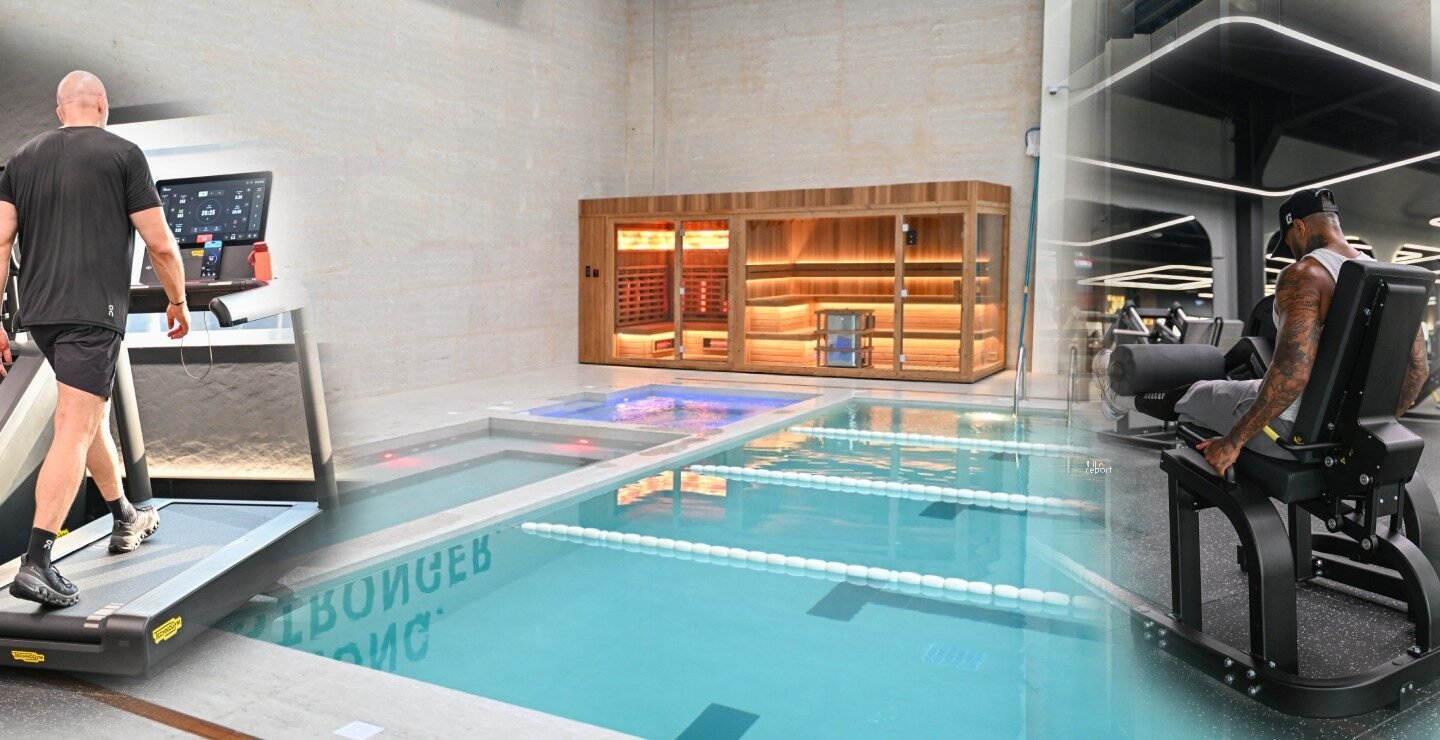
What El Khatib has built is less a gym than a micro-civilisation, a walled city-state of performance and recovery. The facilities read like a love letter to the athletic-industrial complex: a heated 25-metre semi-Olympic pool, ice baths, an infrared sauna, a 250-square-metre physiotherapy clinic, Reformer Pilates studios and a rooftop training deck that offers, presumably, the opportunity to contemplate one’s VO₂ max against the backdrop of Al Quoz. The padel courts, with their soaring 15-metre ceilings, are a nod to the sport’s astonishing regional ascent. The International Padel Federation’s 2024 World Padel Report counted 950 courts in the UAE, underlining just how thoroughly the sport has taken hold. Padel, once a niche racket sport that found an enthusiastic following in Spain, has become the unofficial handshake of the Gulf’s professional classes: perfectly calibrated to the climate (indoor, air-conditioned) and the culture (social, networkable, photogenic).
View this post on Instagram
Partnerships with adidas, Red Bull and Joe & The Juice complete the brand ecosystem, offering the reassuring semiotics of global validation. The roster is impressive, although the Joe & The Juice café was not yet open at the club’s soft launch. There is also a podcast studio, a gaming lounge and a dedicated children’s area with parkour and gymnastics – a tacit acknowledgement that the modern wellness consumer is also, inconveniently, a parent. ‘I know the hassle of any parent is: where do I put my kid?’ El Khatib observes, with the disarming pragmatism of someone who has spent decades reading a court and, evidently, a room.
The location is no accident. Al Quoz, the industrial heartland that is home to Alserkal Avenue and some of Dubai’s most respected contemporary art galleries, has spent the past decade morphing into the city’s most improbable luxury address – a place where espresso machines hum beside welding torches and the rent is justified by cultural proximity rather than sea views. Club 15 slots neatly into this landscape of creative-industrial hybridity, offering the district’s designers, gallerists and founders a place to sweat between studio visits.
The timing is equally deliberate. Dubai’s notably young demographic – six in ten residents are under 35 – forms part of a wider market in which physical fitness has become a serious priority. A YouGov survey found that 58 per cent of UAE residents named physical fitness as their top priority for 2025, while industry research indicates that 62 per cent planned to increase their health and wellness spending. The UAE’s wellness economy was valued at $40.8 billion in 2024, having grown by 14.3 per cent between 2019 and 2024 – the fastest rate in the Middle East and North Africa. The old Dubai bargain – hedonism now, consequences later – has been quietly renegotiated. The new proposition is optimisation now, bragging rights indefinitely. Club 15 is not selling memberships; it is selling a version of the self that is leaner, calmer and marginally more interesting at dinner parties.

Whether it succeeds is, for now, a matter of faith. At the time of the club’s soft launch, membership models and prices were still being finalised, although El Khatib stressed the importance of making the experience attainable. The club’s published opening hours are 6am to 11pm daily, a schedule that suggests its founders understand their congregation: the early-morning devotees and the post-work penitents, the padel obsessives and the parents seeking a sanctioned hour of absence. The philosophy – Prepare. Perform. Recover. Progress. – is printed somewhere, no doubt, in a typeface of impeccable restraint.
In the end, Club 15 is a bet on a simple, slightly melancholy premise: that in a city of relentless reinvention, the most luxurious thing you can offer is a structured place to become someone slightly better. The ice baths are cold, the sauna is hot and the smoothies, one assumes, are immaculately sourced. The rest – the discipline, the progress, the elusive feeling of having optimised something that perhaps did not need optimising – is up to you.
ALSO READ: The AED29,500 Bag That Weighs Almost Nothing: Berluti’s New Definition of Luxury