
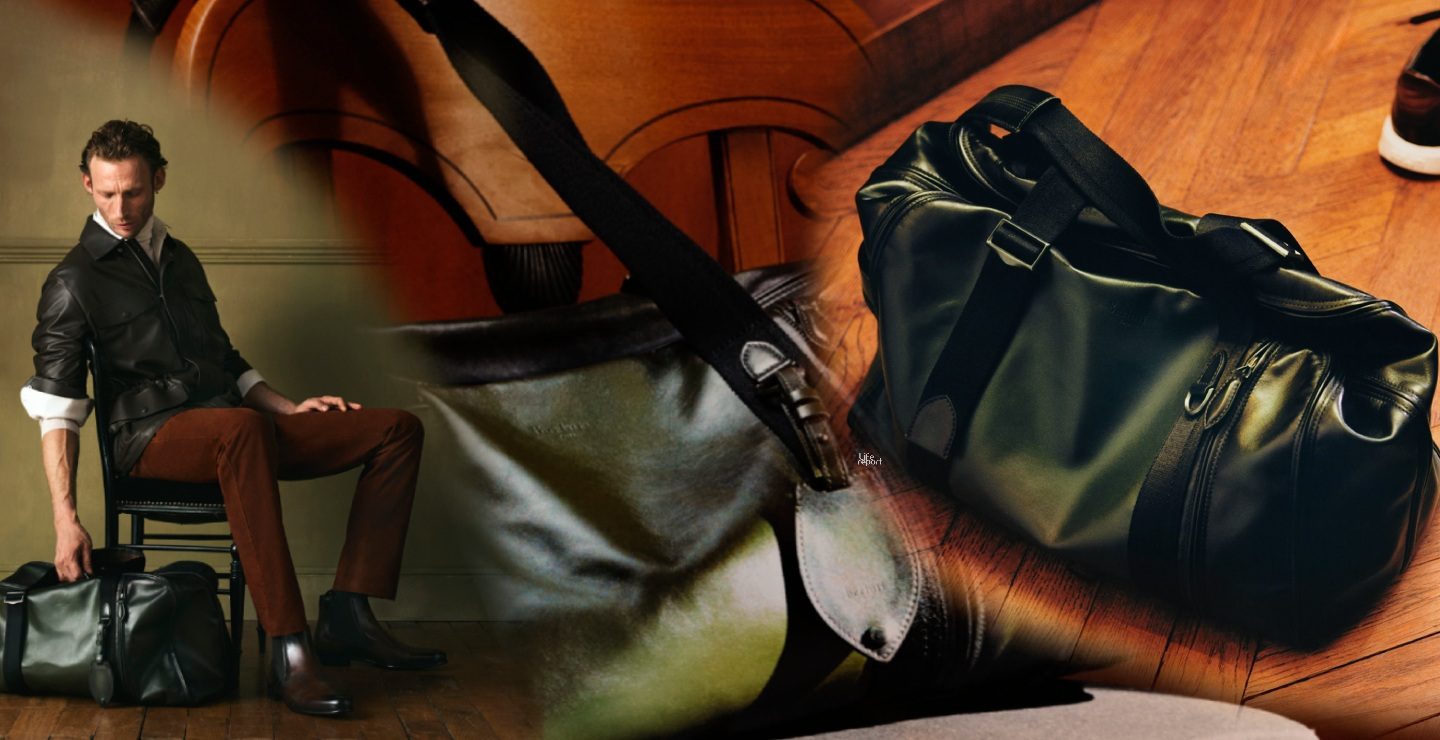
The most subversive thing a wealthy man in Dubai can do this season is carry a bag that refuses to announce itself. Call him the evolved millennial, and he has quietly retired the logo. He still spends, mind you. He simply prefers his luxury to whisper, to move with him and, ideally, to weigh less than his phone. He is the reason the region’s luxury conversation has shifted from “how much” to “how easily”. And he is exactly the man Berluti had in mind when it engineered a leather so light it feels like a rumour.
The Parisian maison, founded in 1895 and folded into the LVMH constellation in 1993, has never been a house that shouts. Its reputation was built on the feet of men who understood that true authority is silent: Yves Saint Laurent, Andy Warhol and, deliciously, Marlene Dietrich were all early devotees of the house’s sculpted patina. What began as a cobbler’s obsession with the architecture of a shoe has, over four generations, become a broader meditation on how a man might inhabit the world without being weighed down by it.
Enter Fly, the Autumn/Winter 2026/27 expression of that meditation and the closest thing the luxury leather goods market has to a philosophical statement about modern mobility. The line’s newest protagonist is a blouson in Fly calfskin, a material developed in-house to achieve that rarest of trinities: astonishingly low weight, incomparable suppleness and the kind of durability that survives the indignities of everyday life. It drapes rather than sits. It moves rather than announces. It is the sartorial equivalent of a well-timed pause. The seasonal offering has since expanded to include a longer Fly leather parka, a silhouette that pushes the idea of fluidity in motion even further, alongside new colours for the B-way that preserve its urban character.
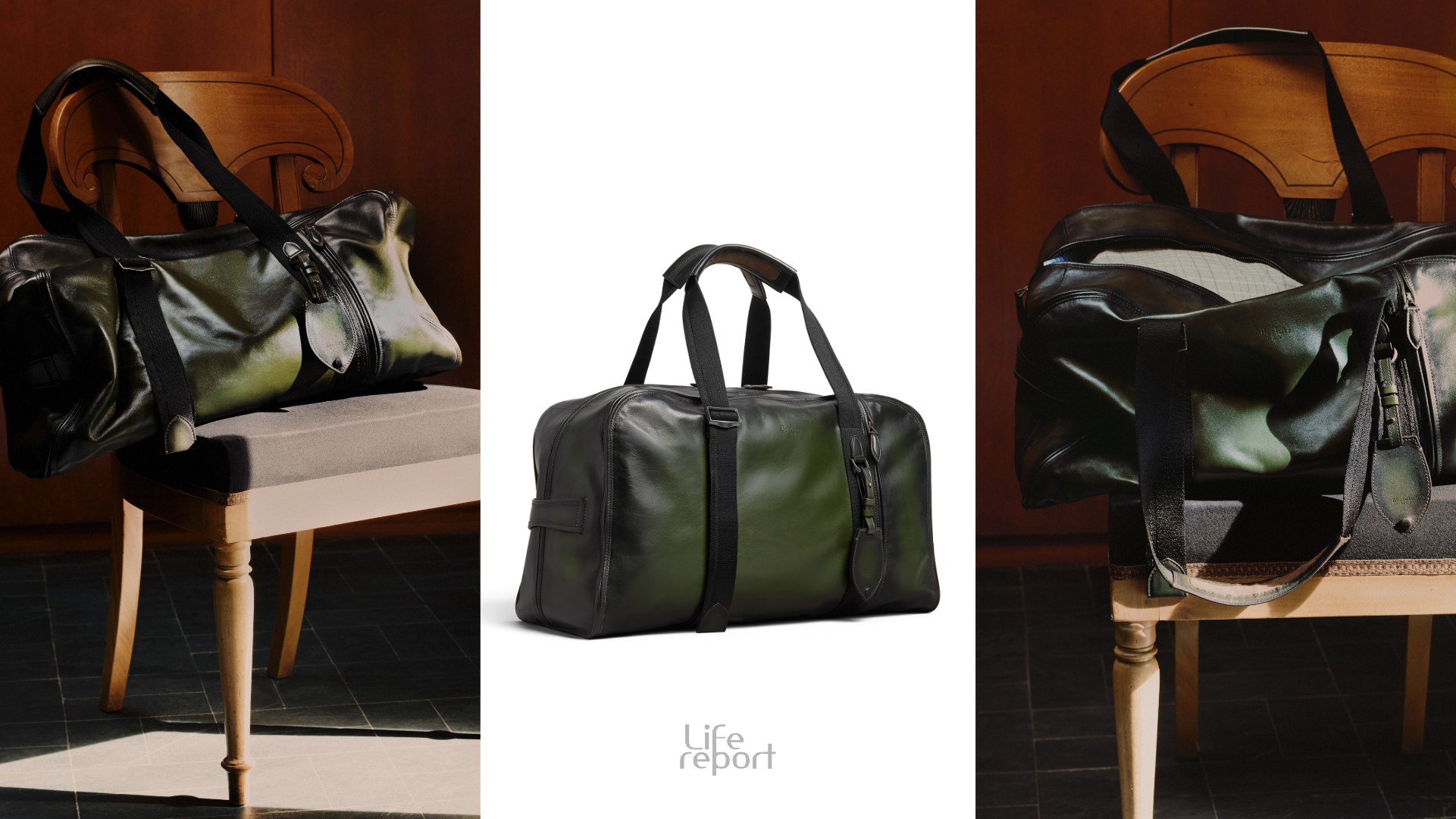
But the real provocation lies in the bags. Berluti has taken Piuma leather – piuma being Italian for ‘feather’ – and paired it with a ripstop nylon lining whose technological ancestry runs straight back to parachutes. The result is a carrying experience so intuitive, so frictionless, that the bag seems to anticipate the hand before it reaches for it. The leather has a subtle sheen that catches the light like a fine watch dial: not with flash, but with depth. In the collection imagery, the material gathers into soft folds, creating a fluidity that makes rigid briefcases look positively Victorian.
Then there is the detail that separates a Berluti object from a merely expensive one. Turn the bag over, and an oversized Scritto signature reveals itself in engineered rubber, retro-injected directly through the leather to create a shock-absorbent, protective base. It is a piece of branding that refuses to be merely decorative. The house’s calligraphic mark is given a job: to meet the ground so the bag does not have to. In a market saturated with signatures that exist only to be photographed, this is a quietly radical proposition: luxury that works from the underside up.
View this post on Instagram
The proportions are equally considered. The Fly 24h measures a compact 45 × 30 × 21 cm, conceived for the daily orbit of a city that rarely slows down. The Fly 72h, at 55 × 35 × 24 cm, is its more expansive sibling, designed for the long weekend that begins with a Thursday evening flight and ends with a Monday morning meeting. Both are made in Italy and feature adjustable nylon handles with leather pads, zipped front and back pockets, interior mesh compartments and a trolley loop – a detail that acknowledges, without fuss, that the modern travel ritual is a relay between car, terminal and cabin. They can be carried by hand or over the shoulder. They sit close to the body. The hands remain free. At Level Shoes in Dubai, the Fly 72h is listed at AED 29,500 – a figure that, in the grammar of Gulf luxury, reads less as a price and more as a subscription to a certain kind of ease.
This is no coincidence. In the Gulf, where a younger, globally connected clientele has grown up with the world’s finest brands at its fingertips, the definition of exclusivity has shifted. A logo is often irrelevant; what matters is whether an object reflects a set of values, a personal narrative and a life lived rather than merely displayed. The region’s Gen Z and younger millennials are not buying status in the old sense. They are buying meaning, and they are doing so with an almost forensic awareness of craftsmanship. They want to know the story of the leather, the intelligence of the lining and the integrity of the base. They want to know that the object they carry was made by someone who understood why lightness is not a compromise but a form of respect – for the body, for the journey and for the hours in between.
Berluti’s own trajectory mirrors this evolution. In recent years, the house has operated without a single creative director, choosing instead to draw on the legacies of the three menswear talents who shaped its ready-to-wear collections from 2011 onwards: Alessandro Sartori, Haider Ackermann and Kris Van Assche. Meanwhile, the atelier’s institutional memory has been allowed to carry the thread. It is an unusual model, and a quietly confident one. The brand does not need a singular auteur to remind you what it stands for. The leather does the talking. The weightlessness does the convincing.
In Dubai, the Fly line finds a natural habitat. The city’s luxury landscape has been undergoing its own recalibration, moving away from the high-octane bling of the 2000s towards something more nuanced: a fusion of maximalism and minimalism that the style press has begun to describe, with some relief, as ‘indulgent yet effortlessly cool’. The Berluti flagship at The Dubai Mall, on the ground floor of one of the world’s largest shopping destinations, has become a quiet destination for clients who understand that the most sophisticated flex is not the thing everyone recognises, but the thing only the right people appreciate. The store offers personalisation and bespoke services, but the Fly bags require no customisation to make their point. Their appeal is structural.
There is, of course, a gentle irony in all this. We live in an age that fetishises optimisation – of schedules, of feeds, of selves – and yet the most desirable object in the room is one that asks nothing of you except to be carried. The Fly bag does not demand that you handle it carefully. It does not punish you for the scuff of a boarding gate or the jolt of a car boot. Its rubber Scritto base absorbs the world so that you do not have to. Its ripstop lining shrugs off the indignities of transit. Its Piuma leather softens with use rather than deteriorating. It is luxury as a form of negative space: the absence of friction, the removal of weight, the quiet gift of not having to think about the thing in your hand.
That, perhaps, is the most accurate definition of elegance available to the modern man. Not the accumulation of signifiers, but the subtraction of burdens. Not the heaviness of heritage, but the lightness of knowing exactly what you are carrying and why. Berluti has spent more than a century perfecting the weight of a shoe on the foot. With Fly, it has turned its attention to the weight of everything else. The result is a collection that does not ask to be admired. It asks to be lived in – lightly, intelligently and with the kind of ease that only looks effortless because someone, somewhere, spent years making it so.
ALSO READ: Guerlain L’Heure Bleue Reinvented: The Fragrance That Bottles Twilight


