The modern home is a carefully curated stage. We agonise over the drape of a linen curtain from The Conran Shop, position a Fornasetti plate just so, and debate the merits of a monolithic B&B Italia sofa against the sinuous curves of a Pierre Paulin ribbon chair. Yet, in the midst of this cultivated scene, a singular, persistent eyesore remains: the Wi-Fi router.
For years, we have treated these plastic, antenna-bristling boxes as digital vermin – shoved behind stacks of Monocle magazines, buried within media consoles, hidden like a guilty secret. Their optimal placement for signal strength wars endlessly with our desire for aesthetic serenity. But what if the solution were not to hide the machine, but to fall in love with it? Enter the Huawei WiFi Mesh X3 Pro, a device that arrives not as an apology for its existence, but as a declarative piece of sculptural technology that dares to become the living room’s most intriguing centrepiece.
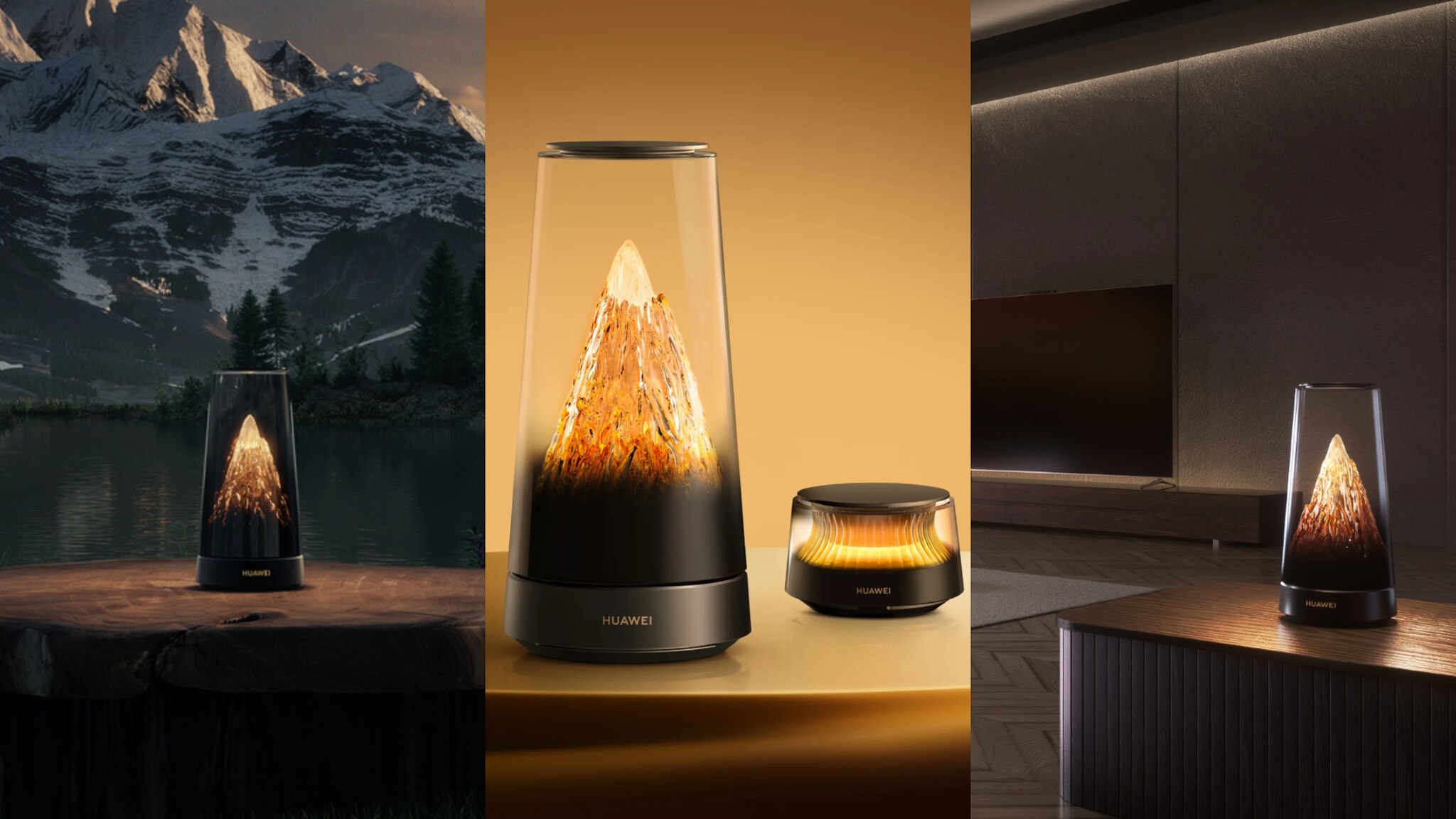
This is not merely a router. It is a tall, translucent cylinder housing what can only be described as a miniature, snow-dusted alpine peak, illuminated from within. Huawei calls this the ‘Golden Mountain Glow Light Effect’ – a poetic turn of phrase that feels more at home in a gallery note than on a specification sheet. The light does not blink with the frantic, robotic anxiety of a standard status LED. Instead, it breathes, shifting imperceptibly from a soft, glacial white to a warm, dawn-like gold, its rhythm tied to the actual weather and time of day. On a cloudy Dubai afternoon, it emits a gentle, diffused glow; at sunset, it may radiate a deeper amber. You can, of course, override this via an app to match your mood – or the evening’s cocktail: a Negroni orange, perhaps. The effect is so convincing that one reviewer made a game of asking guests to identify it; the unanimous verdict was a designer smart lamp, not the powerhouse orchestrating their digital lives.
The New Codes of Luxury: Beyond the Logo
This blurring of boundaries between high-function technology and high-design object speaks directly to a seismic shift in luxury consumption, particularly among Gen Z and millennial cohorts shaping markets from Dubai to London. According to insights from the Altiant HNWZ Report and analysis by Khaleej Times, the old pillars of luxury – heritage, exclusivity, and overt status signalling – are being recalibrated. For a generation projected to dominate 80 per cent of the luxury market by 2030, luxury is increasingly defined by quality, uniqueness, and self-expression. It is less about the label you wear and more about the intentionality of your environment. It is the quiet confidence of an object that is both beautiful and brilliantly capable, valuing longevity and craftsmanship over disposable trendiness.
The Huawei X3 Pro fits this ethos perfectly. Its design is not a slapdash shell, but a functional architecture. Those unsightly antennas that typically give routers their insect-like appearance are ingeniously embedded within the sculpted ‘mountain’ core. This is design in service of performance – a principle any disciple of Dieter Rams would admire. It does not shout; it simply is: a calm, authoritative presence on a sideboard beside a HAY tray or a collectible design book. In a world where sustainability has become a ‘licence to operate’ for younger luxury consumers, an object you proudly display for years is inherently more sustainable than one you hide away and replace without thought.
Performance as an Invisible Service
Of course, a beautiful shell is nothing without a formidable engine. Here, the X3 Pro is equipped with Wi-Fi 7 technology, a standard beginning to redefine connectivity in tech-forward hubs such as the UAE. For the uninitiated, Wi-Fi 7 is not merely about faster speeds – though with dual-band peaks of up to 3.6 Gbps, it certainly delivers. Its true magic lies in Multi-Link Operation (MLO), which allows devices to connect to both the 2.4 GHz and 5 GHz bands simultaneously. Imagine an 8K streaming session or competitive gaming no longer held hostage by a single congested channel; data flows seamlessly across multiple paths, eliminating lag and dropped connections. It is the networking equivalent of moving from a single-lane alley in Bur Dubai to the fluid, multi-lane expanse of Sheikh Zayed Road.

The system’s mesh capabilities are designed for the realities of modern apartments and villas. The main router, capable of covering approximately 90 square metres, partners with elegant, lamp-like satellite nodes to blanket the home in a consistent, high-fidelity signal. For properties with particularly challenging layouts or thick walls, the system can even use existing electrical wiring as a backbone for greater stability. Network management is refreshingly intuitive via the Huawei AI Life app, which presents the connected environment through clean, three-dimensional visualisations rather than intimidating technical jargon.
A Note on Conscious Compromise
Is this the most powerful, hardcore networking system on the planet? For the enthusiast with a server rack humming in a dedicated closet, perhaps not. One long-term reviewer with an extraordinarily dense smart home noted that, under the strain of a hundred-plus connected devices, the system could exhibit intermittent connectivity hiccups. It also offers a more modest selection of Ethernet ports than some dedicated gaming routers. Yet judging the X3 Pro by such criteria is akin to assessing a Savile Row suit by the standards of mountaineering gear. Its genius lies in its holistic proposition. It asks a different question: what is the true cost of that final five per cent of brute-force performance if the machine delivering it is something you feel compelled to banish from sight?
The final, and perhaps most persuasive, argument often comes not from the technology editor, but from the life partner. As one reviewer wryly concluded, after his wife insisted the X3 Pro remain the household router precisely because it ‘meshes with the décor’, the battle was won. He now finds himself having to argue for a return to a more traditionally ‘powerful’, but aesthetically offensive, box – a domestic negotiation familiar to anyone who values both cutting-edge connectivity and a harmonious home.
In the end, the Huawei WiFi Mesh X3 Pro succeeds by reframing the question. It is no longer about how to hide your router, but about why you would ever want to. In the curated landscape of modern luxury, it stands as a testament to the idea that essential technology should not merely serve us, but inspire us.